The Illustrated Collectives
A distributed training run is a bunch of matrix multiplies separated by a small number of communication patterns. Those patterns are the collectives: allreduce, allgather, reduce-scatter, broadcast, all-to-all. Every modern parallelism strategy is a particular sequence of these.
Every collective, in turn, is a schedule of exactly two primitives: a
point-to-point send and a point-to-point recv. To make this concrete, I
handrolled all of them from PyTorch’s
dist.send/dist.recv,
running on CPU via gloo. The code in this GitHub
repo.
This post walks through each collective with a steppable animation. It pays to understand them deeply, because each parallelism strategy maps to collectives directly:
- Data parallel (DDP) is an
allreduceon the gradients. - ZeRO / FSDP is a
reduce_scatteron gradients plus anallgatheron parameters. - Tensor parallel is an
allreduce(orallgather/reduce_scatter) on activations. - Mixture of Experts (MoE) routing is an
all_to_all.
Understanding the collectives lets you see, for example, why ZeRO-2 buys a large memory saving for zero extra communication over DDP, and why deep learning communication libraries almost always pick ring scheduling over tree. Results like these fall out of a simple cost model.
The alpha-beta cost model
Sending a message of $M$ bytes from one rank to another costs
\[T_{\text{p2p}} = \alpha + \beta M.\]$\alpha$ is the fixed per-message latency (the handshake, the kernel crossing, the first byte’s flight time) and $\beta$ is the per-byte cost (the reciprocal of bandwidth). This is the Hockney model. While crude — it ignores congestion and black-boxes topology — it explains well which algorithm wins in what regime.
A collective’s wall time is then
\[T = (\text{messages on the critical path}) \cdot \alpha + (\text{bytes on the busiest link}) \cdot \beta.\]So every algorithm earns two numbers: a coefficient on $\alpha$ (how many sequential message rounds it takes) and a coefficient on $\beta M$ (how many $M$-sized payloads cross the bottleneck link). With $N$ ranks and a total message of size $M$, here is the scorecard for everything in this post:
| collective | pattern | $\alpha$ coef | $\beta M$ coef | notes |
|---|---|---|---|---|
barrier |
pairwise | $N-1$ | – | empty payloads |
broadcast_flat |
flat from root | $N-1$ | $N-1$ | baseline |
broadcast_tree |
binomial tree | $\log N$ | $\log N$ | latency-optimal |
scatter |
flat from root | $N-1$ | $(N-1)/N$ | |
gather |
flat to root | $N-1$ | $(N-1)/N$ | |
reduce_flat |
flat to root | $N-1$ | $N-1$ | baseline |
reduce_tree |
binomial tree | $\log N$ | $\log N$ | latency-optimal |
allgather |
ring | $N-1$ | $(N-1)/N$ | bandwidth-optimal |
reduce_scatter |
ring | $N-1$ | $(N-1)/N$ | bandwidth-optimal |
allreduce_ring |
RS + AG | $2(N-1)$ | $2(N-1)/N$ | bandwidth-optimal |
allreduce_tree |
reduce + bcast | $2\log N$ | $2\log N$ | latency-optimal |
all_to_all |
pairwise | $N-1$ | $(N-1)/N$ | bandwidth-optimal |
Two ways to be optimal. You can minimize rounds — get the $\alpha$ coefficient down to $\log N$ — with trees. Or you can minimize bytes per link — keep the $\beta$ coefficient near a constant, independent of $N$ – with rings. Trees win when $M$ is small and the $\alpha$ term dominates (i.e., when we’re latency-bound); rings win when $M$ is large and the $\beta M$ term dominates (bandwidth-bound). This reasoning is the core of when to use which allreduce algorithm, which we’ll return to later in this post.
Rooted collectives: the flat baselines
The simplest way to move data is to put one rank in charge. These four collectives all have a root that talks to everyone else in a star.
broadcast_flat
The root holds the data and sends a copy to each of the $N-1$ other ranks, one message at a time. The root’s link is the bottleneck: $N-1$ sequential messages, each carrying the full $M$ bytes. This is a baseline we beat later with a tree.
def broadcast_flat(rank, world_size, data, root=0):
    if rank == root:
        for peer in range(world_size):
            if peer != root:
                dist.send(data, dst=peer)
    else:
        dist.recv(data, src=root)
scatter
The root holds $N$ chunks and sends chunk $i$ to rank $i$ — like a broadcast, except each peer receives a different $M/N$ slice rather than the whole thing. Still $N-1$ sequential sends from the root, but only $M/N$ bytes each, so the $\beta$ coefficient drops to $(N-1)/N \approx 1$.
def scatter(rank, world_size, data, root=0):
    # Require data size divisibility by world size. Otherwise, chunks may have
    # uneven lengths, and we'd need either two sendrecvs instead of one (one
    # for chunk size to allocate appropriately-sized buffer, and one for the raw
    # data itself) or padding.
    assert data.numel() % world_size == 0, "data size must be divisible by world_size"
    chunk_size = data.numel() // world_size
    if rank == root:
        chunks = data.chunk(world_size)
        for peer in range(world_size):
            if peer != root:
                dist.send(chunks[peer], dst=peer)
        return chunks[root].clone()
    else:
        buf = torch.empty(chunk_size, dtype=data.dtype)
        dist.recv(buf, src=root)
        return buf
gather
The exact inverse of scatter: every rank sends its $M/N$ chunk to the root, which concatenates them in rank order.
def gather(rank, world_size, data, root=0):
    if rank == root:
        chunks = [torch.empty_like(data) for _ in range(world_size)]
        chunks[root] = data
        for peer in range(world_size):
            if peer != root:
                dist.recv(chunks[peer], src=peer)
        return torch.cat(chunks)
    else:
        dist.send(data, dst=root)
        return None
reduce_flat
Like gather, but the root sums the incoming tensors instead of concatenating them. Each peer sends its full $M$ bytes and the root accumulates, so unlike gather the $\beta$ coefficient is $N-1$, not $(N-1)/N$. Another baseline a tree implementation beats.
def reduce_flat(rank, world_size, data, root=0):
    if rank == root:
        result = data.clone()
        buf = torch.empty_like(data)
        for peer in range(world_size):
            if peer != root:
                dist.recv(buf, src=peer)
                result += buf
        return result
    else:
        dist.send(data, dst=root)
        return None
The pattern across all four: the root performs $N-1$ messages back to back, so
latency scales as $N-1$. scatter/gather move only $M/N$ per message;
broadcast/reduce move a full $M$. The serial root is the weakness; a tree
fixes it.
The binomial tree
The flat algorithms force the root to do all $N-1$ messages sequentially. A tree parallelizes the work: at each round, every rank that already holds the data helps pass it on. The set of holders doubles each round, so after $\lceil \log_2 N \rceil$ rounds everyone has it.
For broadcast_tree with $N = 8$: rank 0 sends to rank 4; then 0 and 4 each
seed a partner (0 to 2, 4 to 6); then those four each seed one more (0 to 1, 2
to 3, 4 to 5, 6 to 7). The holder set goes $1 \to 2 \to 4 \to 8$ in three
rounds instead of seven serial sends. reduce_tree is the mirror image: the
active set halves each round as partial sums fold inward toward rank 0. The
neat implementation trick is that a rank’s lowest set bit tells it which round
it joins in, so the whole schedule is bit arithmetic.
broadcast_tree
def broadcast_tree(rank, world_size, data):
    n_rounds = (world_size - 1).bit_length()
    for k in range(n_rounds - 1, -1, -1):
        distance = 1 << k
        # A rank's lowest set bit is its round of arrival -- the round where it
        # receives the data and joins the holder set. Once it arrives, it
        # remains active for all rounds with smaller k, where it serves as a
        # sender to grow its own subtree.
        # This check: if any lower bit set, rank doesn't receive data yet; skip
        # for a later (smaller-k) round.
        if rank & (distance - 1):
            continue
        # If rank's lowest set bit is k, receive and join the holder set.
        if rank & distance:
            dist.recv(data, src=rank - distance)
        # Data flows from bit-k-clear rank to its bit-k-set peer at rank + 2^k.
        else:
            peer = rank + distance
            if peer < world_size:
                dist.send(data, dst=peer)
reduce_tree
def reduce_tree(rank, world_size, data):
    acc = data.clone()
    buf = torch.empty_like(data)
    n_rounds = (world_size - 1).bit_length()
    for k in range(n_rounds):
        # 1 << k = 2^k. At round 0 you pair with your distance-1 neighbor, round
        # 1 with distance-2, round 2 with distance-4, etc.
        distance = 1 << k
        # Rank with k-th bit set sends.
        if rank & distance:
            # Send our running sum to the peer, then drop out.
            dist.send(acc, dst=rank - distance)
            return None
        peer = rank + distance
        if peer < world_size:
            dist.recv(buf, src=peer)
            acc += buf
    # Rank 0 has all bits zero, so it never enters the send branch and is the
    # only rank to reach this return with the full sum.
    return acc
The payoff: $N-1$ rounds become $\lceil \log_2 N \rceil$ rounds. For $N = 8$ that is 7 down to 3. But the cost: the $\beta$ column — it is also $\log N$, not a constant. Every round still ships a full $M$-byte message on the active links, so the total bytes moved across the critical path grow as $M \log N$. The tree buys latency (fewer rounds) but not bandwidth (it moves more bytes than the flat version, not fewer). The bandwidth fix is in noticing a lower bound on the per-link payload.
The ring
The ring’s observation is that you need never move more than $M/N$ bytes at a time.
allgather
Every rank starts with one chunk; we want everyone to end up with all $N$ chunks. Arrange the ranks in a circle. On each step, every rank sends the chunk it currently holds to its right neighbor and receives a new chunk from its left. After $N-1$ steps every chunk has visited every rank.
Before the schedule proper, an implementation detail: ordering. gloo’s send
blocks once the payload outgrows the kernel’s socket buffer. So if every rank
runs the symmetric “send to my partner, then receive from my partner”, every
rank blocks in send waiting for a matching recv that no peer has reached
yet. The whole group hangs.
The fix is to break the symmetry with a rule both sides can compute independently. The simplest is “even ranks send-first / odd ranks recv-first” (we use its cousin, “lower rank sends first”, for the all-to-all later).
def allgather(rank, world_size, data):
    left = (rank - 1) % world_size
    right = (rank + 1) % world_size

    chunks = [torch.empty_like(data) for _ in range(world_size)]
    chunks[rank] = data.clone()

    send_idx = rank
    for _ in range(world_size - 1):
        recv_idx = (send_idx - 1) % world_size
        if rank % 2 == 0:
            dist.send(chunks[send_idx], dst=right)
            dist.recv(chunks[recv_idx], src=left)
        else:
            dist.recv(chunks[recv_idx], src=left)
            dist.send(chunks[send_idx], dst=right)
        send_idx = recv_idx

    return torch.cat(chunks)
Each step moves only $M/N$ bytes per link, over $N-1$ steps, for a total of $M(N-1)/N$ bytes per link. This is bandwidth-optimal. To end up holding everyone else’s data, each rank must receive at least $M(N-1)/N$ bytes (every chunk but its own), and the ring hits that lower bound exactly. You cannot move fewer bytes. The price is latency: $N-1$ sequential steps, the same as the flat version.
reduce_scatter
The mirror of allgather. Now every rank starts with the full $M$ (all $N$ chunks) and we want rank $r$ to end with the sum across all ranks of chunk $r$. Same ring rotation, except the receiver adds the incoming chunk into its local copy instead of overwriting. After $N-1$ steps, rank $r$ holds the fully reduced chunk $r$.
def reduce_scatter(rank, world_size, data):
    assert data.numel() % world_size == 0, "data size must be divisible by world_size"
    left = (rank - 1) % world_size
    right = (rank + 1) % world_size

    chunks = [chunk.clone() for chunk in data.chunk(world_size)]
    buf = torch.empty_like(chunks[0])

    send_idx = (rank - 1) % world_size
    for _ in range(world_size - 1):
        recv_idx = (send_idx - 1) % world_size
        if rank % 2 == 0:
            dist.send(chunks[send_idx], dst=right)
            dist.recv(buf, src=left)
        else:
            dist.recv(buf, src=left)
            dist.send(chunks[send_idx], dst=right)
        chunks[recv_idx] += buf
        send_idx = recv_idx

    return chunks[rank]
These two are mirror images with identical cost — $(N-1)$ on $\alpha$, $(N-1)/N$ on $\beta M$ — and it is this symmetry that allreduce exploits.
Allreduce, and why ZeRO-2 is free
Allreduce leaves every rank holding the elementwise sum of every rank’s input. It’s the workhorse of data-parallel training: each rank computes gradients on its slice of the batch, and an allreduce averages them so every rank can take the same optimizer step. There are two natural implementations.
allreduce_ring
A reduce-scatter followed by an allgather. After the reduce-scatter, rank $r$ owns the fully summed chunk $r$. An allgather then hands those summed chunks to everyone. That’s the entire implementation:
def allreduce_ring(rank, world_size, data):
    reduced_chunk = reduce_scatter(rank, world_size, data)
    return allgather(rank, world_size, reduced_chunk)
Cost: $2(N-1)$ on $\alpha$ and $2(N-1)/N$ on $\beta M$ — bandwidth-optimal, the factor of two being the unavoidable cost of getting data out and back.
allreduce_tree
A reduce followed by a broadcast. Fold everything to rank 0 with
reduce_tree, then broadcast_tree the result back out. Cost $2\log N$ on both
coefficients — latency-optimal.
def allreduce_tree(rank, world_size, data):
    reduced = reduce_tree(rank, world_size, data)
    out = reduced if rank == 0 else torch.empty_like(data)
    broadcast_tree(rank, world_size, out)
    return out
That first identity — allreduce = reduce_scatter + allgather — explains the free lunch that powers ZeRO-2. In plain data parallel (DDP), every rank stores a full copy of the parameters, the gradients, and the optimizer states. For Adam in mixed precision, the optimizer states (fp32 master weights, momentum, variance) come to roughly three times the size of the parameters themselves. So, across $N$ ranks, you’re storing $N$ identical copies of the chunkiest tensor in the system. Each step: compute local gradients, allreduce them, and every rank runs the identical optimizer update on the full parameter set.
ZeRO (the Zero Redundancy Optimizer underlying DeepSpeed, and the idea behind PyTorch FSDP) shards this redundancy away. ZeRO-1 shards the optimizer states; ZeRO-2 additionally shards the gradients; ZeRO-3 additionally shards the parameters. Specifically, ZeRO-2, instead of an allreduce on the gradients, does:
reduce_scatterthe gradients, so rank $r$ ends up holding the summed gradient for only its shard $r$;- rank $r$ updates only its shard of the parameters, using only its shard of the optimizer states;
allgatherthe updated parameter shards, so every rank has the full parameters again for the next forward pass.
Count the bytes. DDP does one allreduce on the gradients, which is a reduce-scatter plus an allgather under the hood. ZeRO-2 does one reduce-scatter on the gradients plus one allgather on the parameters. Parameters and gradients are the same size, so ZeRO-2 moves exactly the same number of bytes as DDP — same $2(N-1)$ on $\alpha$, same $2(N-1)/N$ on $\beta M$. You get an $N$-fold cut in gradient and optimizer-state memory for zero additional communication.
(The free lunch ends at ZeRO-3. Sharding the parameters means they have to be
allgather-ed back in both the forward and the backward pass, which pushes
total communication to roughly 1.5x. ZeRO-1 and ZeRO-2 are free; ZeRO-3 trades
communication for the ability to fit the model at all.)
Ring vs tree: why deep learning picks the ring
For an allreduce, which algorithm should you pick: ring or tree? Plug $N = 8$ into the scorecard:
- ring: $2(8-1) = 14$ rounds of latency, $2(8-1)/8 = 1.75$ payloads of bandwidth.
- tree: $2\log_2 8 = 6$ rounds of latency, $2\log_2 8 = 6$ payloads of bandwidth.
The tree does fewer rounds (6 versus 14) but moves far more bytes (6 versus
1.75). So the tree wins when $\alpha$ dominates (small messages) and the ring
wins when $\beta M$ dominates (large messages). To reproduce the crossover for
myself, I benchmarked both handrolled allreduces against gloo’s built-in
dist.all_reduce on 8 CPU ranks, sweeping message size. Both log-scale-on-y and
linear-scale-on-y views:
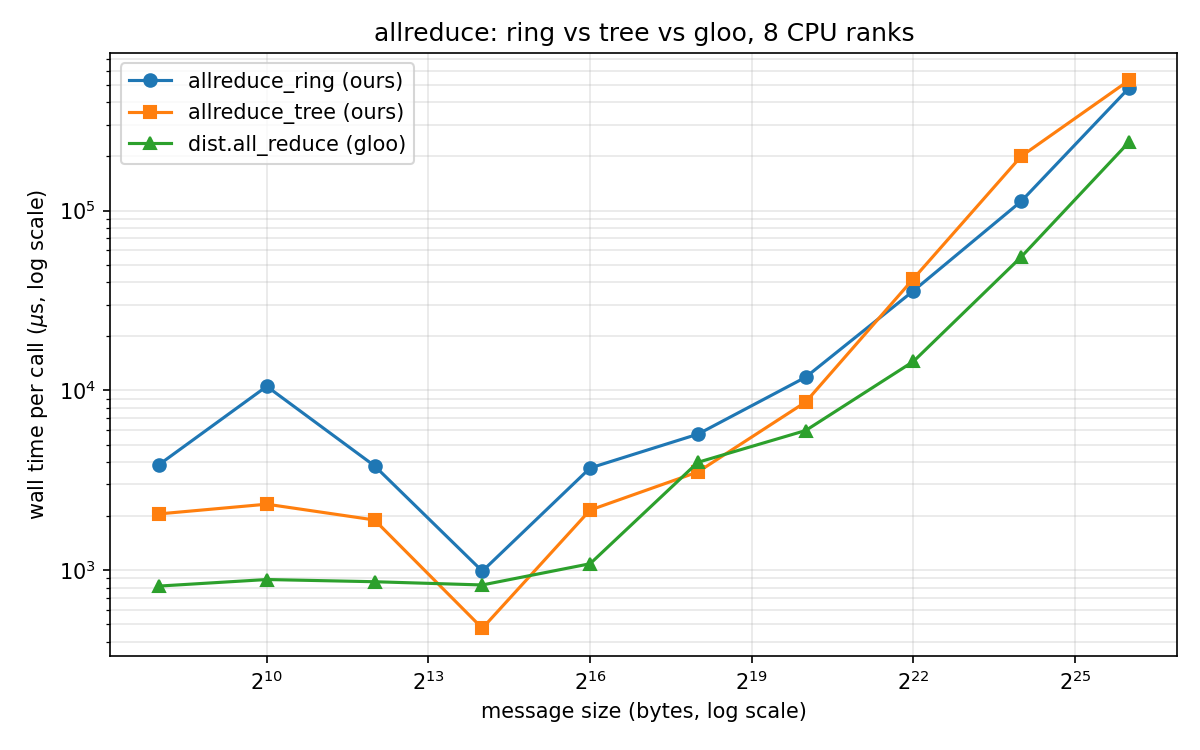
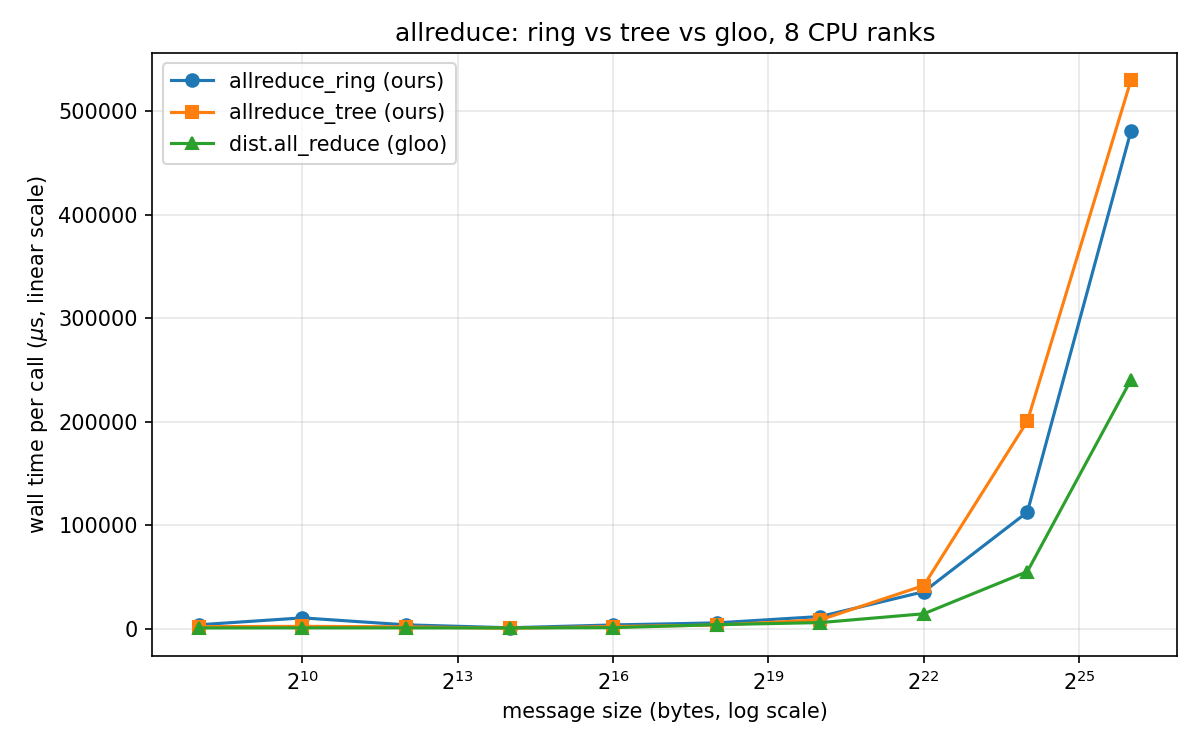
Tree leads through 1 MB, the curves cross somewhere between 1 and 4 MB, and ring wins from 4 MB up (at 64 MB, ring averages about 0.48 s against tree’s 0.53 s). Expectedly, gloo’s C implementation beats both of my Python-loop versions almost everywhere – orchestrating sends and receives from a Python loop incurs overhead.
The deep learning point: gradient buffers are big. A 7-billion-parameter model in bf16 has a 14 GB gradient tensor. Even though DDP buckets the gradients, firing all reduce on every ~25 MB bucket as it fills to overlap communication with the backward pass, a single bucket is already one to two orders of magnitude past the crossover. Deep learning is firmly bandwidth-bound.
This is why, though NCCL keeps a tree algorithm (a clever double binary tree) around for the small-message, latency-bound regime, for averaging gradients it’s rings; the tree’s $\log N$ latency edge matters little when every message is MBs to GBs.
All-to-all, the MoE collective
all_to_all
The final collective is the most general of all. And the most symmetric:
all_to_all is a distributed transpose. Each rank holds $N$ chunks, and chunk
$j$ on rank $i$ goes to rank $j$. After the op, rank $j$ holds the $j$-th chunk
from every rank. Lay the inputs out as an $N \times N$ grid — row = source
rank, column = destination rank — and all_to_all transposes it.
The implementation is $N-1$ pairwise exchanges per rank, one with every other rank, each swapping the $M/N$-byte chunks the two owe each other: bandwidth-optimal at $(N-1)/N$ on $\beta M$. The subtlety is scheduling: if every rank walks its partners in the same order $0, 1, 2, \dots$, they all pile onto the same partner each step and the round serializes as Gloo’s sends block, waiting for a matching recv. Pairing instead by $\text{peer} = \text{rank} \oplus k$ for $k = 1, \dots, N-1$ (when $N$ is a power of two) keeps every rank busy with a distinct partner on every step, so the rounds run in parallel.
Why does XOR give that clean matching? For any fixed $k$, the map $\text{rank} \mapsto \text{rank} \oplus k$ is its own inverse and has no fixed point (XOR by something nonzero must change at least one bit), so it splits all $N$ ranks into $N/2$ mutual pairs — one conflict-free round. And the pair ${a, b}$ is hit by exactly one mask, $k = a \oplus b$, so the $N-1$ rounds together pair every rank with every other one exactly once.
This bizarre butterfly pattern makes much more sense if you visualize it in a higher dimension. With $N = 2^d$ ranks, every rank is a corner of a $d$-dimensional hypercube. Two corners share an edge exactly when their labels differ in a single bit: a coordinate system. XOR-ing a rank by $k$ flips exactly the bits set in $k$, so $\text{rank} \oplus k$ is the corner you reach by stepping along every axis named in $k$ at once. The animation below puts the 8 ranks on a cube and steps through the masks: the gray lines are the cube’s 12 edges, and each step lights up the four pairs that mask $k$ matches.
def all_to_all(rank, world_size, data):
    assert data.numel() % world_size == 0, "data size must be divisible by world_size"
    chunks = list(data.chunk(world_size))
    # Diagonal of the transpose: my own j=rank chunk stays put.
    out = [torch.empty_like(chunks[0]) for _ in range(world_size)]
    out[rank] = chunks[rank].clone()
    ws_is_pow2 = world_size & (world_size - 1) == 0
    for k in range(1, world_size):
        # XOR schedule when N is a power of 2, otherwise the plain linear peer
        # order. XOR-by-k is a fixed-point-free (nobody is paired with
        # themselves) involution (applying it twice gets you back where you
        # started, so the pairing is mutual -- both sides are partners this
        # step). This results in a "perfect matching": every node is paired with
        # exactly one other node, and no node appears in two pairs, i.e., every
        # step cleanly splits all N ranks into N/2 disjoint pairs.
        #
        # In linear peer order, you get a star centered on a single hub instead
        # of a matching, resulting in serialization.
        peer = rank ^ k if ws_is_pow2 else k
        # This guard fires only on the non-pow2 branch since XOR-by-k is
        # fixed-point-free.
        if peer == rank:
            continue
        # Lower rank sends first to break the symmetry.
        if rank < peer:
            dist.send(chunks[peer], dst=peer)
            dist.recv(out[peer], src=peer)
        else:
            dist.recv(out[peer], src=peer)
            dist.send(chunks[peer], dst=peer)
    return torch.cat(out)
A transpose-shaped communication pattern shows up most notably in deep learning
in MoE layers. Experts are sharded across
ranks, and a router sends each token to a few of them. So, after routing, every
rank’s holding a pile of tokens destined for experts that live on other ranks
(exactly the all-to-all layout). Dispatching the tokens to the right experts is
one all_to_all, and gathering the experts’ outputs back to the tokens’ home
ranks is another. MoE training and inference are often all-to-all-bound, which
explains the effort poured into interconnect bandwidth and expert placement.
The code
The full implementations, tests, and benchmark are on GitHub.