Notes on Judaism
This summer, I took Northwestern’s Religion 230: Intro to Judaism. This post collects some of the more interesting things I learned in my reading.
The complicated theodicy of the Hebrew Bible
The Tanakh’s theodicy would seem surprisingly complicated and modern to most newcomers.
The most famous example is the Book of Job. God takes a “satan” up on a wager about whether piety disappears when it’s not met with material reward, and lets him torment a blameless man. Job loses his possessions, his livestock, his children, and is afflicted with painful boils from head to toe. At the end, God shows up in a whirlwind, never explains the suffering, and instead hammers Job about the vastness and wildness of creation (“where were you when I laid the foundations of the earth?”).
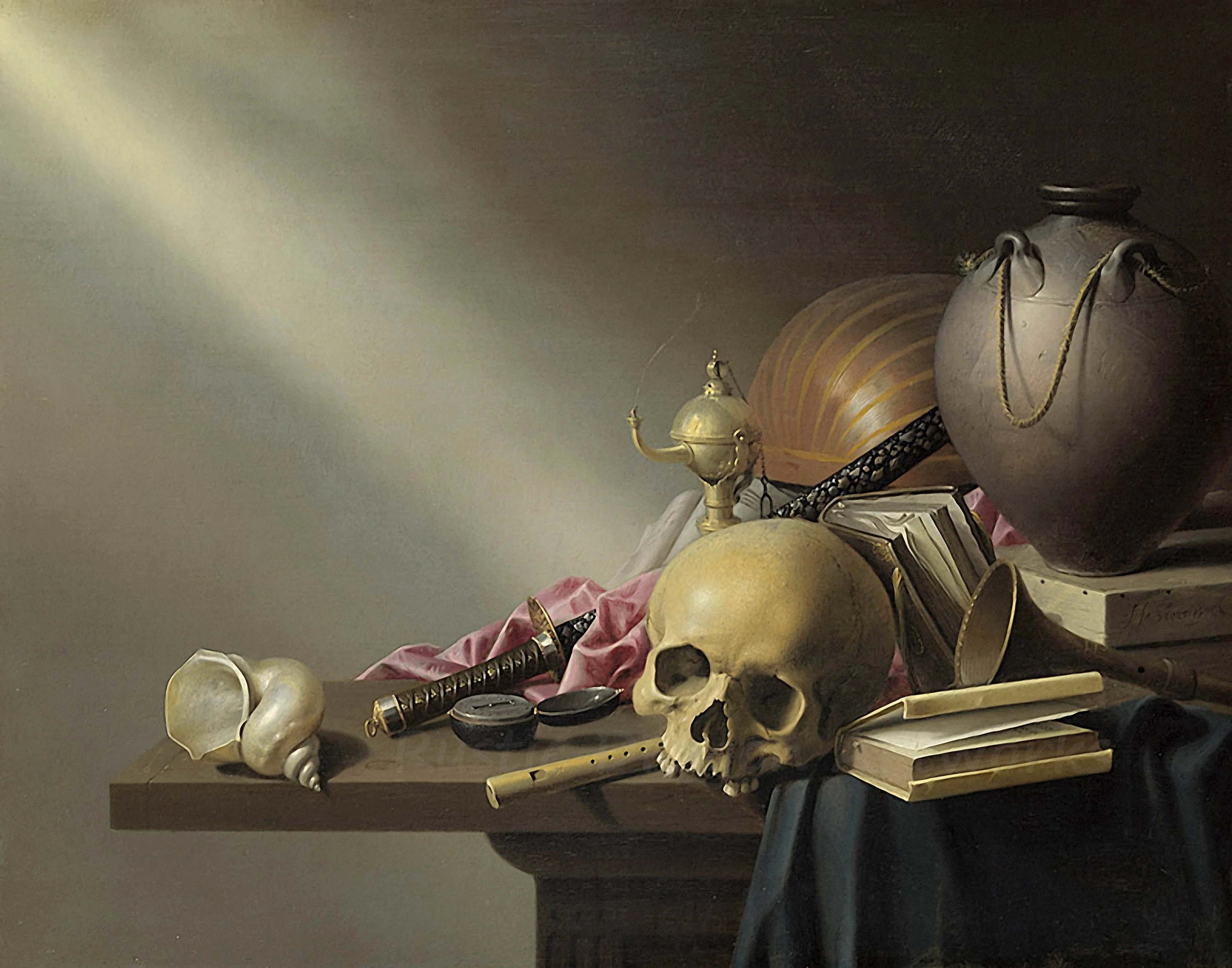
Harmen Steenwijck’s “Still Life: An Allegory of the Vanities of Human Life”, one of the many paintings in the Dutch vanitas genre, which descends from the King James “vanity of vanities” rendering of hevel.

Equally challenging is Ecclesiastes. The Preacher proclaims “Hevel havelim”, that all is insubstantial like mist; the righteous and the wicked both share the same fate, the wise and the foolish both die. The prescription to this squarely existentialist observation is Camus-type too: eat your bread, drink your wine, and enjoy your work.
God lets a human, Abraham, bargain with him: how many righteous inhabitants would it take to spare Sodom and Gomorrah, the cities whose aggregate “outcry” of wickedness has reached heaven? This fable is meant to make the point that God keeps a reasoned covenant with man, but it also shows a God who’s not beyond moral engagement.
There are morally uncomfortable episodes: Abraham’s son Isaac left blind after the Akedah according to midrash, and the slave woman Hagar used and cast out.
The Tanakh resists flatness even outside the theodicy. There are morally complex heroes — King David has an affair with Bathsheba and arranges for her husband Uriah to be killed in battle, and what “saves” him is repentance (“I have sinned”). One of the books of the Tanakh is a narrative that never mentions God — Esther — and another is erotic poetry that had to be reinterpreted as allegory — the Song of Songs.
The Hebrew Bible and Western literature
Alongside Greco-Roman myth, the Hebrew Bible is one of the two great substrata of Western literature. Here are just some examples to illustrate the depth of its imprint.
The Exodus is the ur-narrative of liberation from bondage and is echoed in African-American spirituals, MLK’s final speech (“I’ve been to the mountaintop … I’ve seen the promised land”), and, of course, Watership Down, in which a group of rabbits flees a doomed warren for a promised land guided by Fiver’s prophetic visions. The Exodus is the messianic-liberation myth which forms the lens through which it’s productive to analyze even those messiah stories that aren’t drawing from it, like Frank Herbert’s Dune.
The Cain-and-Abel structure — two brothers, one favored, one not, ending in fratricide — frames John Steinbeck’s East of Eden (where Cain goes after the murder). William Faulkner’s Absalom, Absalom! invokes David’s rebellious son, and Leonard Cohen’s “Hallelujah” invokes David’s affair with Bathsheba. Ishmael, the spiritually adrift narrator of Moby-Dick, invokes Hagar’s son who is cast out and wanders in the wilderness, and Captain Ahab invokes the king of Israel who sets himself up against a much more powerful God and dies in battle he was warned against.
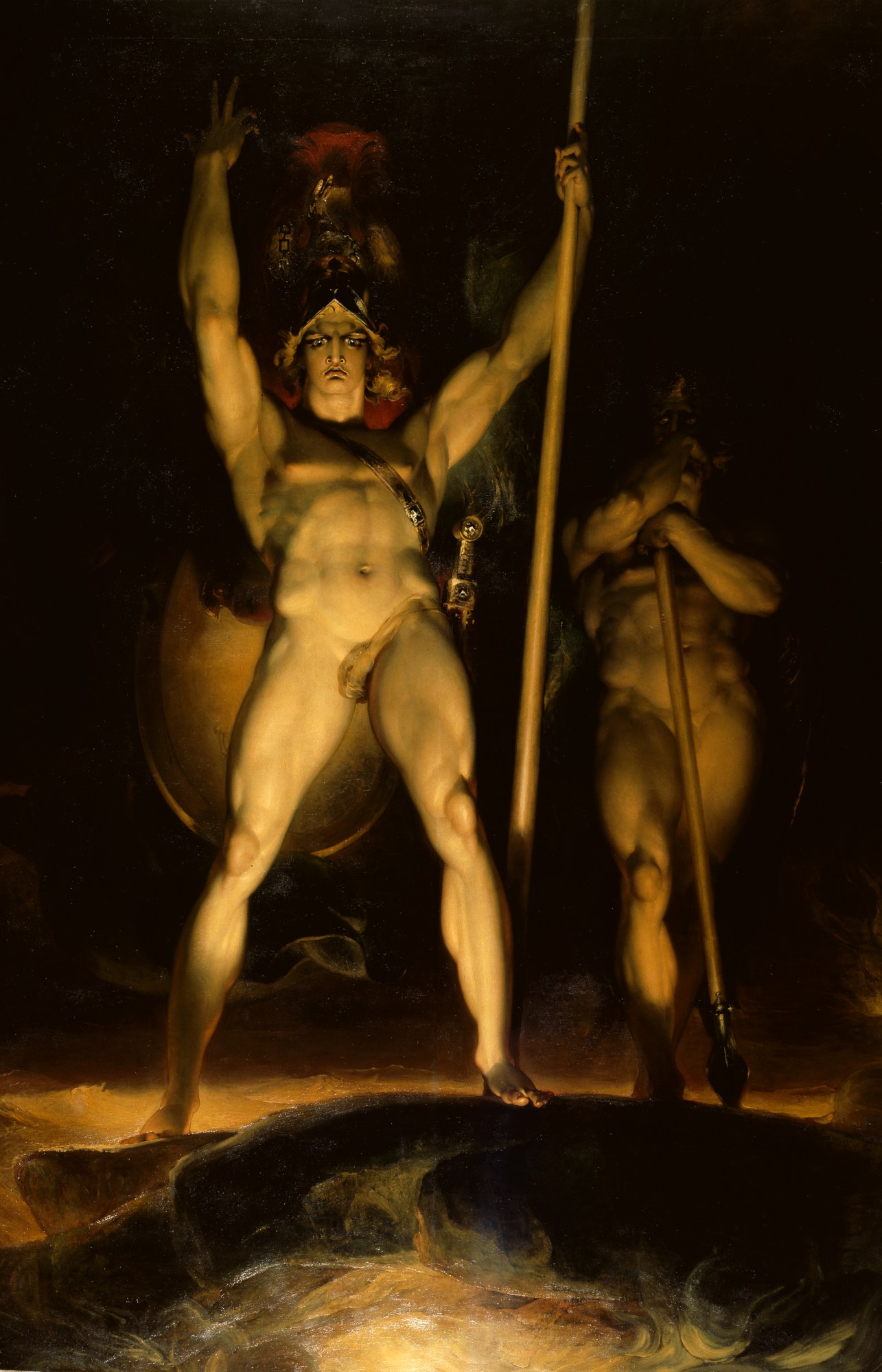
The grand, Romantic Satan summoning his legions in Thomas Lawrence’s 1797 painting.

From Genesis, John Milton spun Paradise Lost, which invented the sympathetic antihero Satan that Romantic novels like Wuthering Heights drew from. Philip Pullman’s His Dark Materials inverts the Fall as liberation rather than sin. Atwood’s MaddAdam trilogy draws on the Flood. Carlo Collodi’s Pinocchio makes the belly of a giant sea creature the ground of moral proving, like the whale in the story of Jonah. McCarthy’s No Country for Old Men has Ecclesiastes nihilism, and the relentless “and … and … and” of his Blood Meridian is the King James Bible cadence (see, e.g., Genesis 1).
Just as deep as the narrative beats is the proliferation of Hebrew idioms in English, via King James: “apple of my eye”, “skin of my teeth”, “a man after his own heart”, “fall flat on his face”, “pour out one’s heart”, “a drop in the bucket”, “from strength to strength”, “an eye for an eye”. (The medieval Yiddish gives American English “schlep”, “schmooze”, “schmuck”, “schtick”, “spiel”, “mensch”, “chutzpah”, “tchotchke”, “putz”, “klutz”, “maven”, “nosh”, “kvetch”, and the “schm-“ reduplication in e.g. “fancy-schmancy”.)
Why just one God?
Across human history, some form of polytheism or animism (a crowded world of non-human spirits and deities) is the default. True monotheism — one god, flat denial that any others exist — is rare: arguably just the Abrahamic traditions, Zoroastrianism, Sikhism, and some strands of Greek and Hindu philosophy that arrived there by first-principles reasoning. Attempts to impose monotheism top-down have especially ended poorly: the canonical case study is the 14th c. BCE pharaoh Akhenaten, who imposed the sole worship of Aten (the sun-disk), suppressed other cults, and closed temples. His monotheistic revolution collapsed the moment he died, and his city was abandoned and his name chiseled out and damned.
So why did the Israelite tradition adopt monotheism?
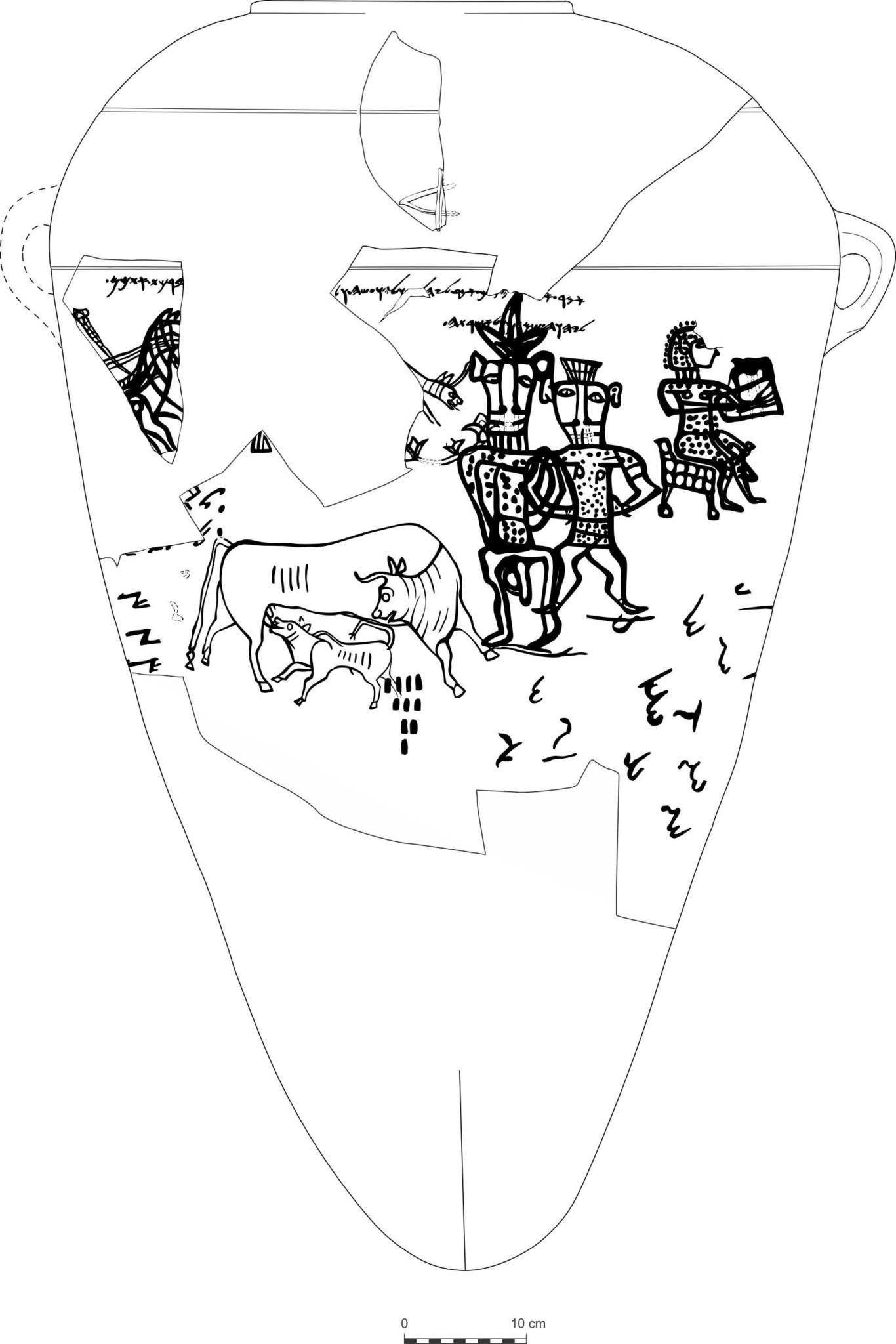
The Kuntillet Ajrud inscriptions depict two human-bovine figures with a lyre-player to the side, and above, the phrase: “Yahweh of Samaria and his Asherah”.

First, on the road to monotheism was monolatry, worshipping one god exclusively while still granting that other gods exist. YHWH began as one deity among many in Canaan, in a pantheon headed by El. The biblical prophets rail against Baal worship and Asherah poles precisely because these were mainstream and popular. The winners wrote the Bible, so the majority practice is framed as apostasy. But the archaeological evidence is strong that it was simply the religion of most of the people. The 800 BCE Kuntillet Ajrud inscriptions bless “YHWH and his Asherah”, who is often taken to be his consort goddess. Thousands of fertility goddess figurines, altars, and high places have been found in domestic contexts across Judea, including in Jerusalem. The first commandment’s grammar itself is suggestive: “no other gods before me” commands loyalty rather than denial that others exist.
The move from monolatry to monotheism was probably precipitated by the Exile. This is close to the leading scholarly theory, most associated with Rainer Albertz and Mark S. Smith. If YHWH is merely your national god, then Babylon’s conquest means Marduk beat YHWH. But if YHWH is the only god, then the conquest was YHWH’s own doing, a punishment for failed covenant.
The primary evidence for this theory is textual: the first clearly explicit denial that other gods exist coincides with the Babylonian exile. The mid-6th c. BCE Second Isaiah repeats “I am the first and I am the last; besides me there is no god” until the foreign nations concede “God is only in you, and there is no other”. Before this, you find monolatry, supremacy, and incomparability (“Who is like you among the gods, O YHWH?” in Exodus, “none like you among the gods” and “a great King above all gods” in Psalms, and YHWH being one of the “sons of God” whose apportioned nation is Israel in the Dead Sea Scrolls’ Deuteronomy).
Why not pronounce the Tetragrammaton?
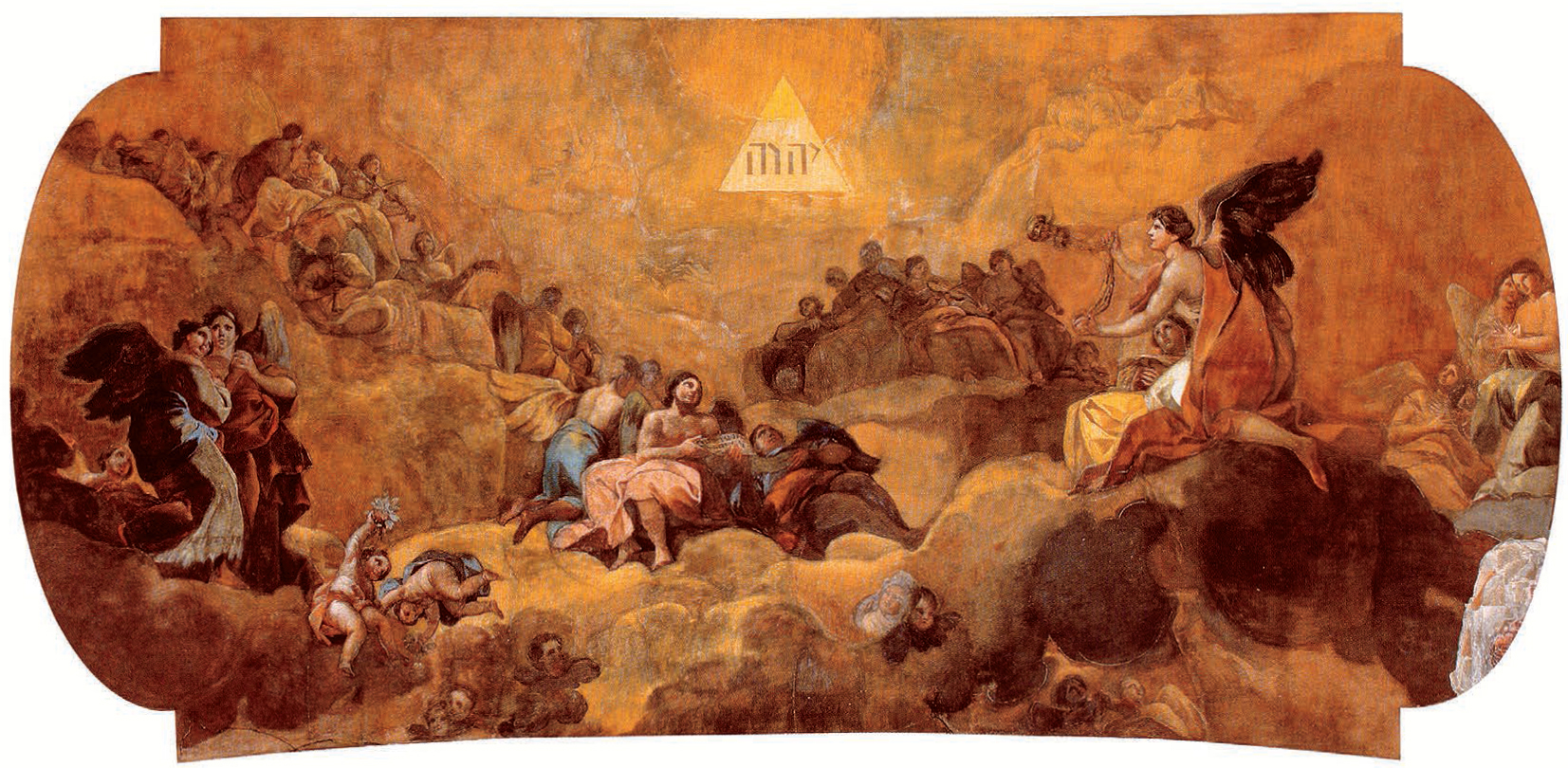
Francisco Goya’s fresco “Adoration of the Name of God” in a Catholic church — a tradition that feels less anxiety about the Name.

Jews haven’t pronounced the Tetragrammaton YHWH since at least 70 CE. The correct vocalization is one of the most successful antimemes in history: it’s literally lost to time, and “Yahweh” is simply our best guess.
At first blush, this is surprising: Christians and Muslims share the commandment to avoid taking the name in vain, but the utterance itself isn’t banned.
The explanation is that YHWH is a proper name, while “God”, “Lord”, and “Allah” (al-ilah, literally “the God”) are titles. Tabooing personal names is actually common across religions — ancient Egyptians held that the gods had hidden “true names”, Romans kept the “secret name” of the guardian deity under wraps, and many societies avoid speaking the names of the dead or of chiefs — and Judaism formed in exactly a world that believed that speaking a deity’s true name conferred power over it.
The other main reason is that this is just another instance of a common rabbinic legal move. The rabbis built a protective fence around a commandment so you never even approach violating it, and given a command against misusing the name, the safest fence is never saying it at all. Christianity demoted halakhic fence-building from Paul onward (grace over law) so it was especially immune to an injunction to never take the name.
The modernness of the Talmud
.jpg)
A page of the Vilna Edition of the Talmud, with the Mishnah and the Gemara down the center block, Rashi’s commentary to the right, the Tosafot to the left, and references in the outer margin.
.jpg)
The core of the Tanakh is the Torah — the Written Law, God’s revelation at Sinai. But the written text often underspecifies how to do what it commands: it says “do no work on the Sabbath” without defining work, or “bind these words as a sign on your hand” without instructing how. Rabbinic Judaism holds that at Sinai, alongside the Written Torah, God gave an Oral Torah: an applied tradition transmitted verbally across generations. Prophetic revelation had ended before the rabbinic era, so the job of the sages and the rabbis was to interpret this Torah. When catastrophe struck — the destruction of the Second Temple in 70 CE, the failed Bar Kokhba revolt against Hadrian in 135 CE, and the resulting slaughter and displacement — generations of rabbis (the Tannaim), culminating in Rabbi Judah ha-Nasi, compiled the Oral Torah to keep it from getting lost. This became the Mishnah. It’s organized into six orders covering agriculture, Shabbat and the festivals, marriage and divorce, civil and criminal law, Temple sacrifices, and ritual purity.
But the Mishnah is terse, imprecise, internally inconsistent, free-floating of the biblical text, and doesn’t tell you who won a dispute (“Rabbi Eliezer says A, the Sages say B”). So, generations of rabbis (the Amoraim) debated it; the record of these debates is the Gemara. The Talmud is the Mishnah plus the Gemara. Its authoritative Babylonian version, called the Bavli, was completed around the 6th c. CE. The Talmud is sprawling — around 2 million words. Its two great codifications strip away the debate to state the final ruling: Maimonides’ Mishneh Torah in 1180, and Joseph Karo’s Shulchan Aruch in 1565.
A popular sentiment is that the Talmud was a massive expenditure of seriously-limited-at-the-time literate human brainpower on complete trivialities.
Exhibit A are the huge chunks of the Gemara devoted to working out how to operate institutions that were already rubble. The fifth of the six orders is about a Temple that had been destroyed for centuries by the time the Gemara was completed, and discusses things like what vessel a priest should catch sacrificial blood in. There are also debates on matters where the precision outruns the stakes: how many hairs constitute a sign of adulthood, the minimum dimensions of a sukkah in handbreadths, the exact moment of nightfall.
But these discussions were often whetstones for legal reasoning about time, intention, and burden of proof. The reasoning got applied to matters a secular humanist would consider important, like contracts, damages, and criminal liability. And in these matters, Talmudic law is surprisingly modern as often as it is predictably pre-modern and patriarchal (regarding the status of women and slavery, for example).
Most notable: the rabbis abolished the death penalty in practice, despite inheriting a Torah full of capital offenses. The procedural requirements were so exacting — two eyewitnesses to the act, no circumstantial evidence, formal prior warning to the offender — that conviction was nearly impossible. The Talmud also forbids self-incrimination in capital matters: this is stronger than the Fifth Amendment, which protects against compelled self-incrimination but permits a voluntary confession to convict.
The Talmud episode best-known in legal theory is the Oven of Akhnai story, which establishes that majority rule supersedes divine judgment. A rabbi losing an argument calls on miracles and a voice from heaven to declare him correct, but is rejected by a rabbi who quotes Deuteronomy: “It is not in heaven.” Since the Torah was already given at Sinai, no heavenly voice is needed anymore, because the Torah itself says “incline after the majority”. God smiles at this and says, “My children have defeated me, my children have defeated me”.
Also worth noting are affordances in the Talmud to allow future law to be written without pronouncing the Torah or the Talmud wrong. For example, rabbis cannot permit what the Torah forbids, but they have uncontested authority to restrict something the Torah permits. This is specifically what let Rabbeinu Gershom ben Judah ban polygamy and divorcing a wife without her consent, since Deuteronomy only permits a man to take a second wife, and the Mishnah only permits a man to divorce his wife without her will.
Why did Islam inherit Abraham?
;_Abraham_cast_into_fire_by_Nimrod_(bottom).jpg)
An Ottoman miniature: above, Abraham prepares to sacrifice his son, who in the Islamic telling is Ishmael rather than Isaac, and below, he sits unharmed in Nimrod’s fire.
;_Abraham_cast_into_fire_by_Nimrod_(bottom).jpg)
Islam is, alongside Judaism and Christianity, an “Abrahamic religion”.
Islamic monotheism is essentially the Israelite one — a single, incorporeal creator God who communicates through prophets and goes by “Allah” (a name cognate to the Hebrew “Eloah”). The Quran’s roster of prophets draws from the Tanakh — Moses, Abraham, Noah, Joseph, Adam, Isaac, Jacob, David, Solomon, Elijah, Jonah, Job, Jesus — and Islam acknowledges prior revealed books: the Tawrat (Torah) to Moses, the Injil (Gospel) to Jesus. And sharia parallels the halakha in both structure and the concrete overlaps — pork forbidden, ritual slaughter, circumcision, daily prayer, dietary categories (halal/haram mirror kosher/treif).
The origin myth of the Arab Muslim people sees Abraham as hanif — neither Christian nor Jew but a pure, upright monotheist — who fathers Ishmael (who Arabs trace descent from) and builds the Kaaba at Mecca together with him.
What was the political reason Muhammad appealed to these roots at all?
The mainstream scholarly explanation is that Judaism and Christianity were the prestigious religions in 7th c. Arabia — they had a written scripture, a long history, and a literate scholarly class. Claiming the Abrahamic lineage bestowed upon the movement an ancient pedigree. It was also an affordance so that the Jews of Medina would recognize Muhammad as a prophet in their theological terms. A good illustration: earlier, Jerusalem was the qibla, and Muhammad’s sirah documents a redirection to Mecca only after the Medinian Jewish tribes rejected his prophethood.
Kabbalah and Sufism
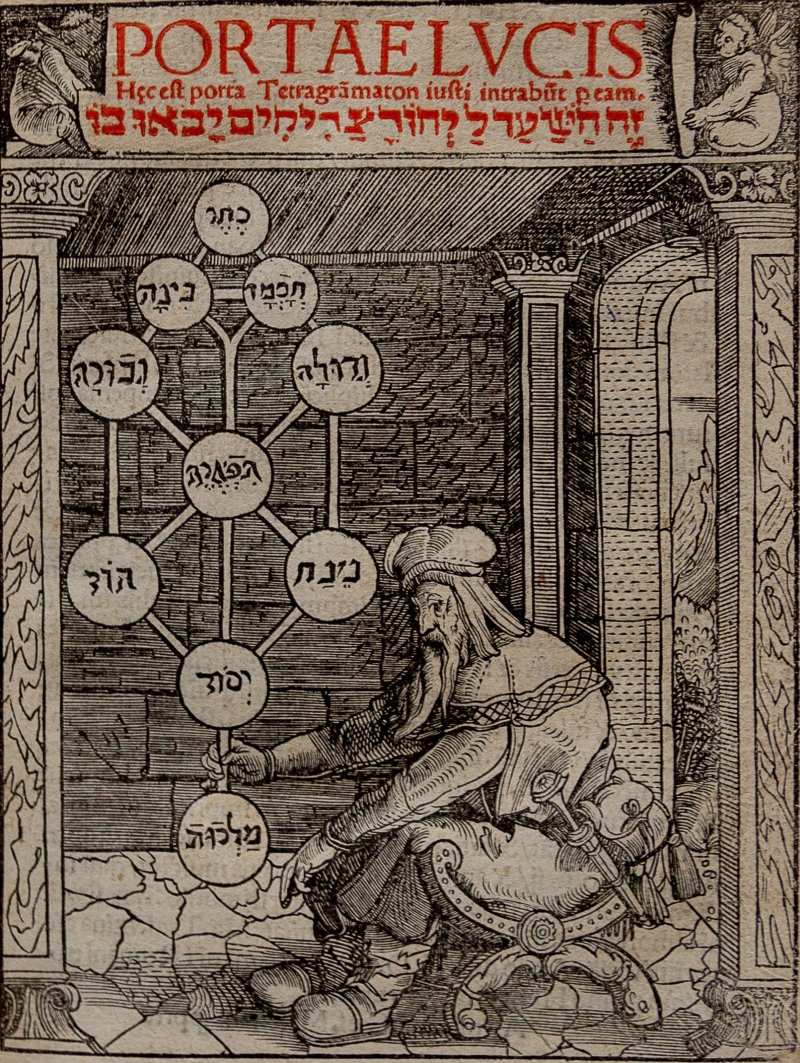
The frontispiece of Portae Lucis — the first appearance of the sefirot in print.

In 12th c. Spain, Kabbalah began as a mystical response to cold Maimonidean rationalism that held you could only truly speak of what God is not. Its foundational text, the Zohar — composed by Moses de Leon in the 1280s but presented as the thousand-year-old teaching of the sage Shimon bar Yochai in Aramaic — splits God into a hidden Infinite (Ein Sof) and ten sefirot through which he acts.
On its face, the parallel to Sufism is striking. Islamic theology distinguishes between the Essence (dhat) and the Names and Attributes (asma wa-sifat) through which God creates, and the rhythmic invocation-based contemplation on these names in Sufism resembles Kabbalistic meditation on the letters of God’s names. Sufism’s Perfect Man mirrors Kabbalah’s Adam Kadmon, and both systems have an eros-laden conception of the divine.
The one core divergence rhymes with the willingness in Judaism in general to let man disagree with God. Kabbalah claims that human ritual acts upon the divine — a proper mitzvah repairs the sefirotic realm — while Sufism is bound by Islamic theology which doesn’t permit God being altered by human action.
The revival of Hebrew
Hebrew stopped being anyone’s cradle language by the 3rd c. CE, and ran for the next seventeen centuries mostly as the language of prayer, Torah study, contracts, and poetry.
The popular story holds that one obsessive revived it into a popular vernacular. Eliezer Ben-Yehuda decided that a national revival needed a national language. He brought up his son in a hermetically Hebrew-only bubble, raising plausibly the first native Hebrew speaker in over a millennium, and coined vocabulary for all modernity had that the Hebrew Bible didn’t. The more defensible story recognizes the role played by Hebrew-medium schools across the Yishuv and Hebrew’s convenience as a shared language that was nevertheless no immigrant’s partisan vernacular.
The core motivation for the revival was that Zionism was the negation of exile, and Yiddish and Ladino were exile languages. Hebrew was ancient and prestigious. This is also why the movement picked Sephardi pronunciation as the standard even though the vast majority of revivers were Ashkenazi and pronounced their prayers the other way. Sephardi sounded older and more authentically “Levantine”.
Today, Hebrew has over 9 million total speakers, of whom over 6 million speak it natively. Ironically, Yiddish, the mother tongue of most of the Ashkenazi revivers, has about 600,000 speakers, and Judeo-Arabic is at around 240,000. Ladino is in even worse shape: just over 50,000 speakers.
Why all the Nobels?
22% of all Nobels, 30% of Turing Awards, 23% of Fields Medals, 28% of Abel Prizes, 30% of Lasker Awards, and 44% of world chess championships have gone to Jews, a community that is 0.2% of the world population. In physics, Albert Einstein, Niels Bohr, Max Born, Wolfgang Pauli, Richard Feynman, Robert Oppenheimer, Edward Teller, and Leo Szilard were Jewish. In math, Alexander Grothendieck, Leopold Kronecker, Andre Weil, Paul Erdos, Hermann Minkowski, Emil Post, Carl Jacobi, and Emmy Noether were Jewish. The towering John von Neumann was Jewish. In economics, Milton Friedman, Kenneth Arrow, Paul Samuelson, Gary Becker, George Akerlof, Ludwig von Mises, and David Ricardo were Jewish. In medicine, Jonas Salk, Albert Sabin, Paul Ehrlich, Rosalind Franklin, Karl Landsteiner, Tadeusz Reichstein, Sydney Brenner, David Baltimore, Gregory Pincus, and Drew Weissman were Jewish. Mahler, Gershwin, Mendelssohn, Kafka, Proust, Freud, Durkheim, and Marx were Jewish.
What explains the Jewish — especially Ashkenazi — overachievement?
There are two favored explanations. First, the cultural emphasis on education among Jews is arguably no different from that in other middleman minorities which, excluded from landowning and political power, turn to portable human capital: overseas Chinese, Armenians, Lebanese, Parsis, and Gujaratis. Second, the Eckstein and Botticini argument from The Chosen Few: since the destruction of the Second Temple in 70 CE, literacy was an expectation of every man so he could study the Torah for himself. This seeded a culture that prioritized education, and pushed Jews out of farming (where literacy has low payoff) and into finance, medicine, and crafts: trades selected for and habituated to book learning. Other religions did develop scholarly traditions, such as Islamic ulama, Christian monasteries, and Brahmin Vedic learning, but Judaism didn’t confine the expectation of scholarship to a clerical or elite class. This is possibly because in Christendom, Islam, and Vedic India, scholarship was one prestige track alongside landholding, soldiering, and public office. After the loss of land and sovereignty in 70 CE, these tracks were no longer available to Jews. Education was the clearest way to accrue communal status, and this set a literacy floor.
Why the Ashkenazi preeminence?
Even granting the cultural explanation for Jewish overachievement in the sciences and the letters, why are most of these overachievers Ashkenazi? The prior favors the Islamic world, which was more tolerant of Jews. In Umayyad Spain, Jews were in the subordinate but protected legal category of dhimmi, and exchanged ideas with Muslim intellectuals. The leading legal authorities of the Jewish world to whom responsa (legal queries) were addressed were the heads of the great Babylonian academies Sura and Pumbedita. In Europe, on the other hand, Jews were massacred during the Crusades, faced blood libels, and were pushed into moneylending, which reinforced resentment. Indeed, the big medieval Jewish intellectuals were overwhelmingly Sephardi: Maimonides, Judah Halevi, Solomon ibn Gabirol, Samuel ha-Nagid. What changed?
First, the population base rates flipped. For much of the medieval era, most of world Jewry lived under Islam. But from 1500 to 1900, the Jewish population of Eastern Europe exploded, largely because Poland-Lithuania actively invited Jews and protected their legal status. By 1900, the Ashkenazim were over 80% of world Jewry.
Second, the answer is essentially the same as the one to the question of why Europe became an economic powerhouse while the Islamic world stagnated. Whatever the reasons for the Great Divergence, the Ashkenazim found themselves in exactly the cities where the Enlightenment was founding universities and creating modern science and art: Vienna, Berlin, Budapest, Warsaw, and Prague.
Growing Orthodox numbers
Orthodox communities in the US are growing. This runs against the typical intuition where the more traditional wing of a religion shrinks as a society secularizes.
The core reason is fertility. Orthodox Jewish adults have 3.3 children on average, while non-Orthodox Jews have an average of 1.4 children. Second, intermarriage, which correlates strongly with children not being raised Jewish, is virtually absent among the Orthodox: 98% of married Orthodox Pew respondents have a Jewish spouse, versus 56% of all married Jews having a Jewish spouse. Finally, retention among the young is high: the share of Jews who identify as Orthodox is higher among the young than the old.
Unit 8200
Unit 8200, Israel’s cyber intelligence unit, is arguably peer-level with the NSA and the GCHQ. Its headline accomplishment is Stuxnet, the computer worm that took down Iran’s Natanz uranium enrichment facility. The hall of fame includes the espionage malware Flame and Duqu, the blinding of Syrian air defense during the Israeli airstrike on the Al Kibar nuclear reactor, and technical support in the 2024 exploding pagers attack against Hezbollah leaders.
Interestingly, Unit 8200 is a startup launchpad. The founders of Palo Alto Networks, Wiz, Waze, Check Point, and NSO Group were all alumni. The first and most obvious reason for this is 8200’s intense talent selection pipeline: technically brilliant high schoolers are enrolled, for example, into a cybersec afterschool program which provides useful screening signal. The other key reason is that argued in the book Start-up Nation: Israel has national conscription, and the Israeli military hierarchy happens to be unusually flat. IDF soldiers “have minimal guidance from the top, and are expected to improvise, even if this means breaking some rules. If you’re a junior officer, you call your higher-ups by their first names, and if you see them doing something wrong, you say so.” Rank and age don’t matter much “when taxi drivers can command millionaires and 23-year-olds can train their uncles”, and “Israeli forces regularly vote to oust their unit leaders”.